
The Essential BRoof (t4) Site Checklist: How to Guarantee Fire-Safe Roofing Installations in 2026

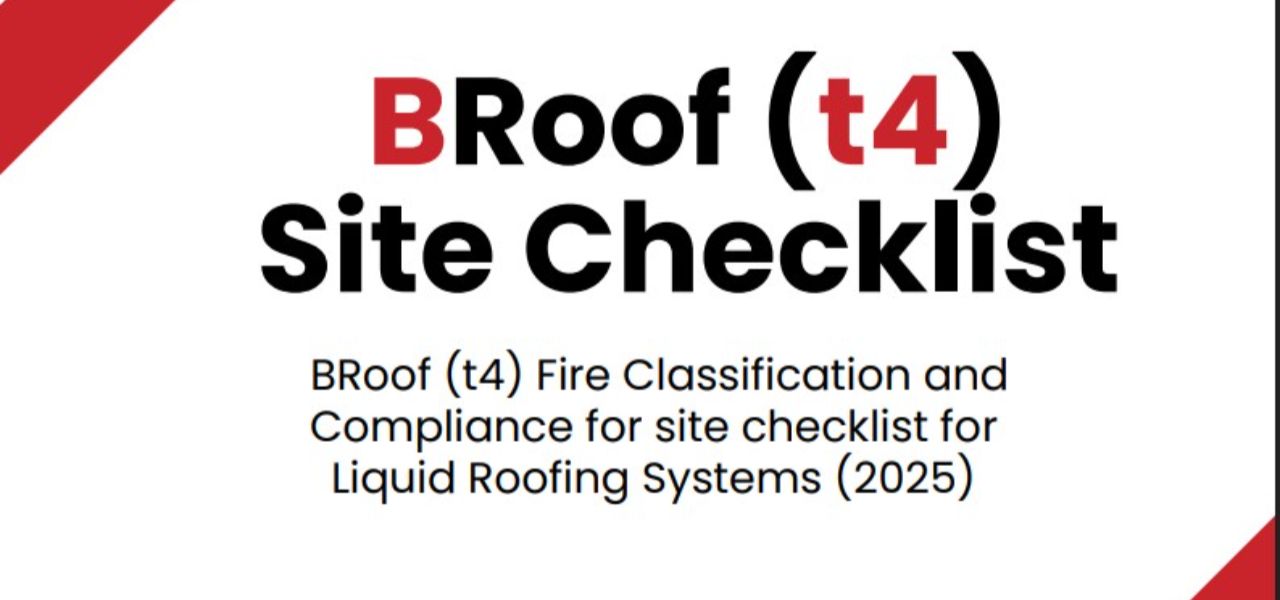
BRoof Checklist Featured Image

When it comes to flat and low‑slope roof installations, achieving BRoof(t4) compliance isn’t just best practice — it’s a regulatory requirement. To help contractors, specifiers, and building control teams avoid the most common causes of non‑compliance, Tricel has created a clear, step‑by‑step BRoof(t4) Site Checklist designed to keep every project aligned with EN 13501‑5 and TS 1187 Test 4.

Below is a practical overview of how the checklist supports fire‑safe, regulation‑ready liquid roofing installations.

1. Start With the Right Build-Up: Pre-Construction Essentials

Before work begins, the checklist requires full confirmation that the proposed roof build‑up is tested and certified — including deck type, insulation, primer, membrane, and finish layers.
This prevents design‑stage mistakes such as untested substitutions or incompatible materials. Full technical data sheets, test reports, and any necessary EXAP (Extended Application) documents must be reviewed at this stage.
 

It also instructs project teams to check installer qualifications, ensuring only TriRoof‑approved installers carry out the work.

2. Control the Variables: Pre-Start Site Preparation

Before installation begins, contractors must verify that the roof substrate is dry, clean, structurally sound, and exactly matches the certified build‑up.

The checklist also emphasises the importance of:

  • Confirming material batch numbers
  • Reviewing method statements
  • Ensuring all operatives understand detailing requirements

This stage helps avoid the common issue of mismatched materials arriving on site.

3. Installation: Build Exactly What Was Tested

During installation, the checklist reinforces the golden rule of BRoof(t4):

No substitutions. No deviations. No shortcuts.Teams must follow the tested system precisely, including:

  • Correct primers and membranes
  • Uniform coverage and curing times
  • Fully compliant detailing (upstands, outlets, terminations, penetrations)
  • Use of approved accessories only

Detailing in particular is highlighted as critical to fire performance.

4. Documentation: The Compliance Folder that Protects the Project

A comprehensive site file is essential for building control, insurers, and future legal protection.
The checklist outlines exactly what must be included:

  • Batch numbers
  • Delivery notes
  • Installation photos
  • QA checklists
  • Signed installation certificates
  • Relevant BRoof(t4) test reports

This creates a transparent compliance trail — something increasingly expected under the Building Safety Act.

5. Final Inspection & Handover

Before handover, the checklist requires a complete inspection to confirm that:

  • All areas are correctly coated
  • No deviations exist
  • All detailing matches the certified specification


A full compliance folder must be ready for building control, and the checklist supports arranging an optional technical sign‑off for complex or high‑risk projects.

6. Post-Completion: Warranty & Record Retention

Once the project is complete, teams must issue warranty documentation and ensure that all records are securely stored for future reference — vital for insurance and regulatory requirements.

 
The checklist ends with reminders covering the essentials: stay within the tested build‑up, use approved installers, document everything, and contact technical support if variations are needed.

Why This Checklist Matters

The TriRoof BRoof(t4) Site Checklist helps eliminate the small errors that can lead to major fire‑safety failures. By following each step, contractors and specifiers can deliver:

  • Fully compliant installations
  • Risk‑reduced project delivery
  • Cleaner building control approval
  • Stronger documentation for warranties and insurers

In a regulatory landscape where compliance is non‑negotiable, this checklist turns best practice into a repeatable process.

Read More...